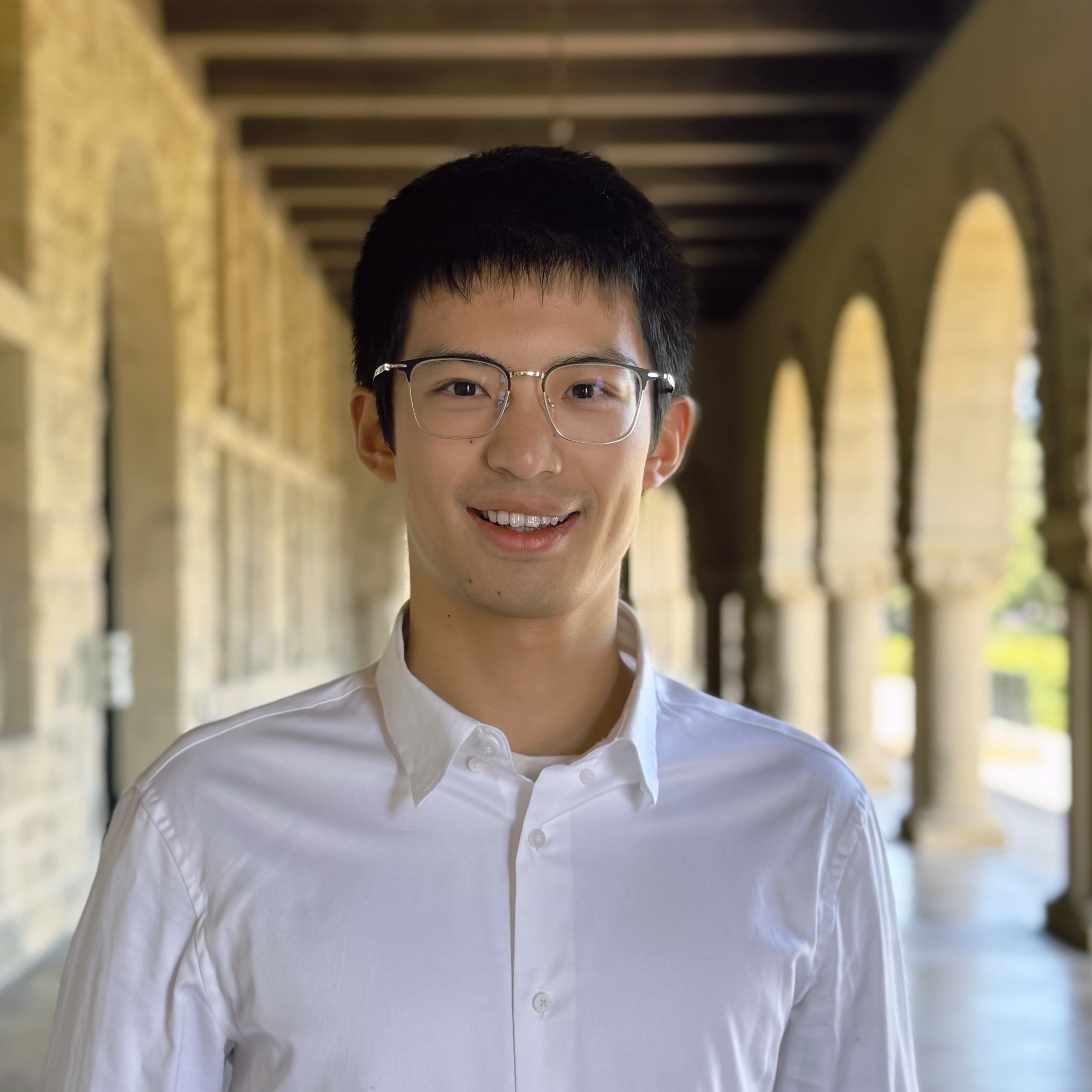
Qianzhong Chen 陈钱中
PhD Student in Aeronautics & Astronautics at Stanford University
I am a PhD student advised by Mac Schwager. My goal is to build general-purpose robots that can perform complex manipulation tasks in homes and factories.
My research spans vision-language-action models, world models, robot policy reward modeling, and reinforcement learning. Previously, I worked on end-to-end drone navigation, legged locomotion, and differentiable simulation.
Education






Learning robots that improve through experience
I work across policy learning, predictive models, and autonomous systems to make robots more capable, adaptable, and useful in the physical world.
Robot manipulation
Building versatile robot policies for complex, long-horizon manipulation tasks in homes and factories.
Learning from experience
Enabling robots to improve from demonstrations, autonomous rollouts, reward models, and reinforcement learning.
World models
Learning predictive representations of visual appearance, geometry, and dynamics for planning, control, and policy training.
Publications
LMAO-World: Loco-Manipulation VLA Optimization in World Models
A teleoperation-free framework that combines simulated demonstrations and play data with autonomous real robot rollouts to train video world models for reinforcement learning of whole-body humanoid loco-manipulation policies.
SARM2: Multi-Task Stage Aware Reward Modeling for Self Improving Robotic Manipulation
A multi-task, stage-aware reward modeling framework that produces dense rewards for long-horizon manipulation, enabling VLA policies to improve from low-cost autonomous rollouts.
GRaD-Nav++: Vision-Language Model Enabled Visual Drone Navigation with Gaussian Radiance Fields and Differentiable Dynamics
A lightweight onboard vision-language-action framework that trains in a 3D Gaussian Splatting simulator and follows natural-language drone commands in real time.
News & recognition
Started at Amazon Fauna as an Applied Scientist Intern.
GRaD-Nav++ received the IEEE RA-L 2025 Best Paper Award.
SARM was accepted to ICLR 2026 and added to Hugging Face LeRobot.
GRaD-Nav++ was accepted to IEEE Robotics and Automation Letters.
ARCH and ParticleFormer were accepted to CoRL 2025.
Admitted to the Stanford Aeronautics & Astronautics PhD program, advised by Mac Schwager.
Education
- PhD, Aeronautics & Astronautics, Stanford University
- MS, Mechanical Engineering, Stanford University, 2025
- BS/BEng, Mechanical Engineering, UIUC & Zhejiang University, 2023
Honors
- IEEE RA-L Best Paper Award, 2025
- Stanford Aero-Astro PhD Fellowship, 2025
- Outstanding Undergraduate Thesis Award, ZJU, 2023
- First Class Academic Scholarship, ZJU-UIUC Institute, 2022
Academic service
- Reviewer: IEEE TRO, IEEE TRL, IEEE RA-L, IEEE IoT, IEEE TIE
- Reviewer: CoRL 2026, NeurIPS 2026, IROS 2025 2026, ICRA 2026
- Member, IEEE Robotics and Automation Society